1. Choose your plan
Pick the tier that matches how much support you want — full coaching across both theory and practical, or a focused package for one alone. Every plan includes a set number of submissions each month, so you always know exactly what’s included.
2. Submit your work
Upload a timed theory essay or a set of tasting notes, just as you would in the real exam. Choose the paper and question you’re answering — from a growing bank of real past questions, or type your own if you’re working from something else entirely.
3. Track your progress
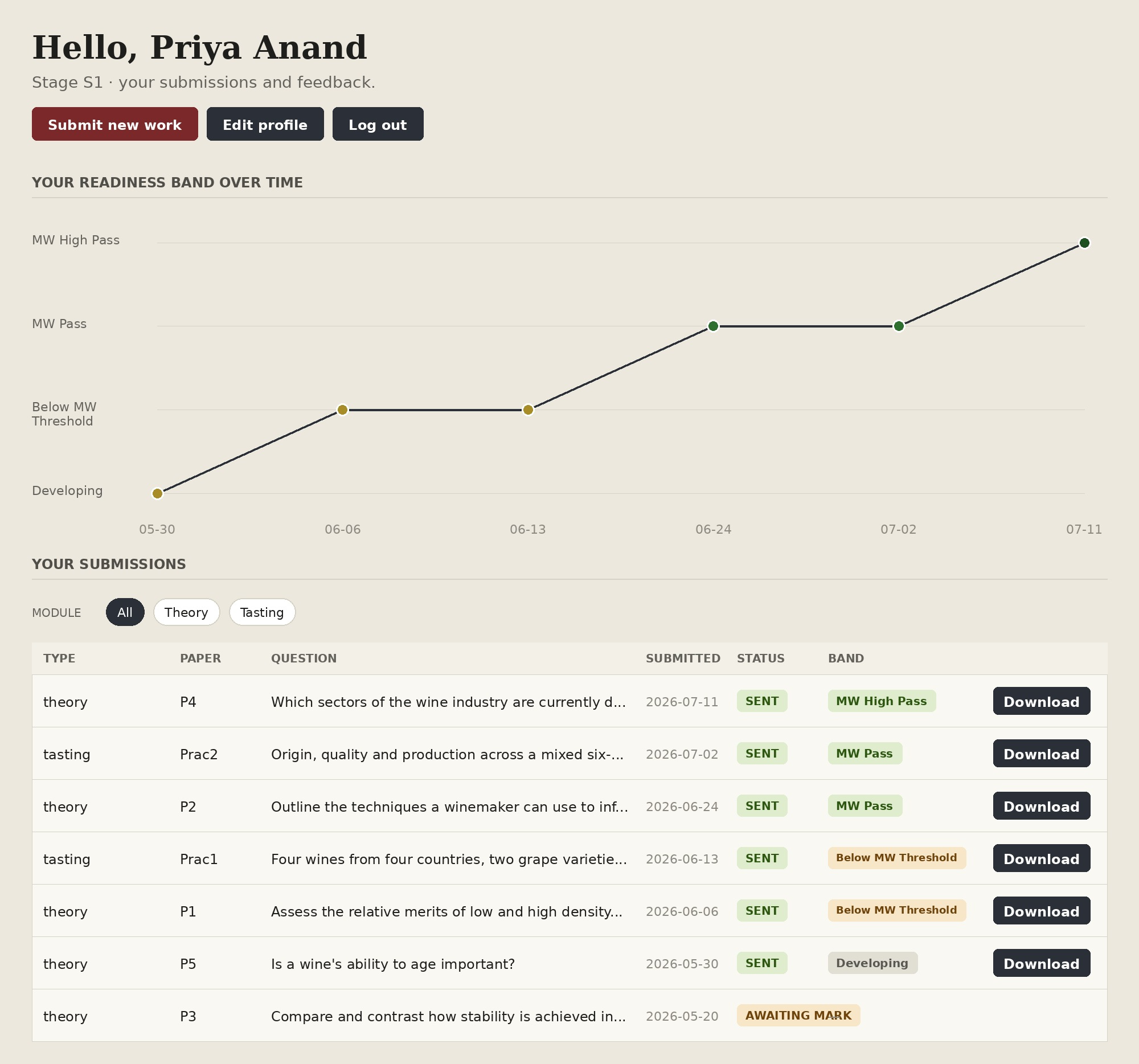
This is where it becomes genuinely different from anything else available to MW candidates today. Every submission — theory and practical alike — lands on one dashboard, tracked over time against the marked readiness bands: Developing, Below MW Threshold, MW Pass, and MW High Pass.
You’ll see your own trajectory build submission by submission — not just your last result, but whether you’re actually improving, and where. A rising line tells you something a single mark never can: that the changes you’re making are working. Filter by paper, by module, by month — and see, at a glance, exactly where you stand.
Nothing like this exists for MW candidates today. Feedback has always arrived one essay at a time, with no thread connecting one mark to the next. This gives you that thread.
4. Your data, handled properly
Your password is never stored in plain text. Every submission and every mark is kept on secure, encrypted infrastructure, visible only to you and to Richard. Nothing is shared, sold, or used for anything beyond your own coaching.
What your feedback actually looks like
Theory essays
You’ll receive a full marked-up Word document, built the way a real MW exam paper should be read.
- Inline comments, anchored to the exact sentence they refer to — not a general summary you have to match back to your own writing yourself.
- The best bits and the single biggest fix, explicitly named, so you know immediately what to keep doing and which one change would move you furthest.
- A full summary and readiness band, telling you plainly where you stand: Developing, Below MW Threshold, MW Pass, or MW High Pass.
- Richard’s own recommendations, at the end of every document — specific, practical advice for what to do differently next time, not just a description of what went wrong this time.
Practical dry tasting notes
This is a dry tasting exercise, marked on the quality of your reasoning — including how you argue your way toward identification, not just whether you land on the right answer. A wrong conclusion, reached through sound, evidenced logic, earns real marks. A right answer with no reasoning behind it does not.
- Inline comments, anchored to the exact line of your note they refer to — showing precisely where your evidence was strong, where it pointed nowhere, or where a conclusion arrived before the reasoning that should have led to it.
- The best bits and the single biggest fix, named explicitly across the whole set — so you know immediately which piece of reasoning to keep doing, and which one change would gain you the most marks.
- A full summary and readiness band, telling you plainly where you stand: Developing, Below MW Threshold, MW Pass, or MW High Pass.
- Richard’s own recommendations, at the end of every set — specific, practical direction on where your reasoning needs sharpening, not just a description of what went wrong this time.
Feedback concentrates on exactly where you can gain marks: whether your evidence actually points where you say it does, whether you’ve led with the observation before the deduction, and where your reasoning on quality, maturity, production, and commercial judgement could be sharper or more specific. This is about building the discipline of the argument, wine by wine, question by question — not correcting your palate.