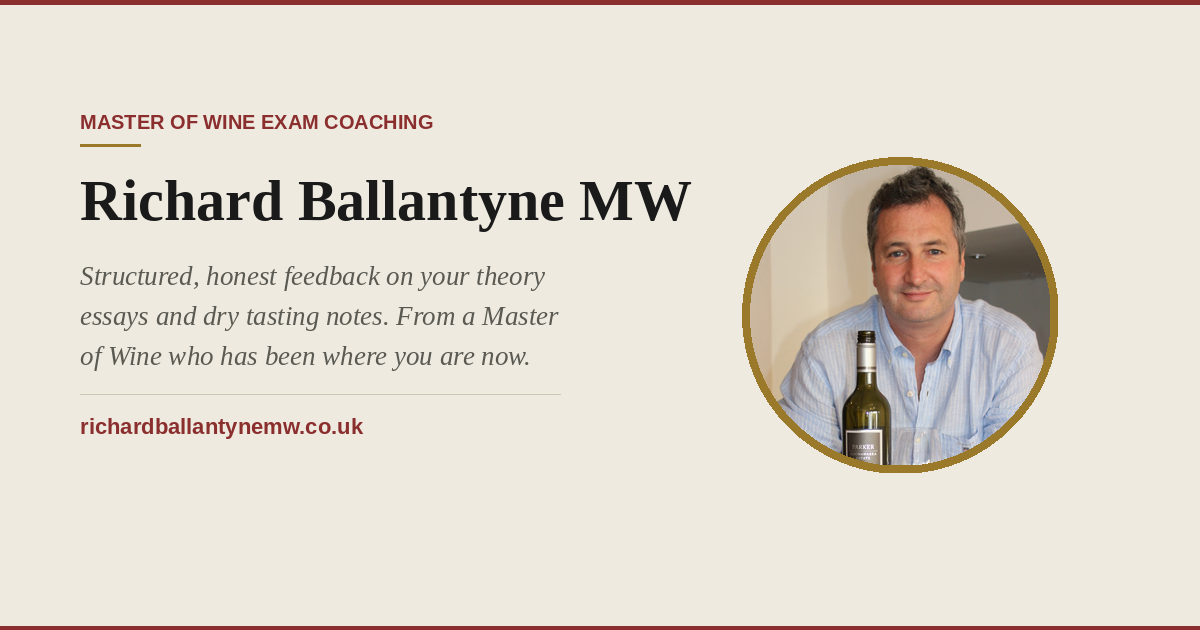
by Richard Ballantyne MW
The Master of Wine theory exam is one of the hardest academic tests in the wine world. The pass rate hovers around 20%. Four out of five candidates fail. Most of them fail not because they lack knowledge but because they don’t answer the question, don’t structure their argument, or don’t show the examiner they can think critically about what they know.
This guide is what I wish someone had given me before I sat the exam. It covers the principles that apply across all five papers, then the specific demands of each paper, and finally the traps I see students fall into year after year. Everything here is informed by the IMW’s own examiners’ reports, which I have studied across multiple years, and by my experience coaching MW students through the theory exam. The patterns are remarkably consistent. The examiners keep saying the same things because candidates keep making the same mistakes.
Knowing these principles is necessary. It is not sufficient. Every candidate I work with understands them intellectually within a few weeks. The gap between understanding them and consistently applying them to your own writing, under pressure, on a question you have never seen before, is where the real work happens. That gap closes only with practice, honest feedback, and rewriting. There are no shortcuts.
If you are a current MW student, a serious candidate preparing to join the programme, or a Diploma holder wondering what the step up looks like, this is for you.
Contents
- Before You Write a Word: Planning
- How to Translate the Question
- Define Your Terms
- Writing the Introduction
- Leading with the Principle, Not the Example
- Evidence and Examples
- Show the Trade-Off
- Writing the Conclusion
- Writing Style
- Paper by Paper: What Each Paper Demands
- The Traps: What Fails Year After Year
- Why Reading This Guide Is Not Enough
- One Final Thought
Before You Write a Word: Planning
I used to plan for 20 to 30 minutes of the allotted hour. That sounds extreme. It is not. The planning is where you pass or fail the essay. The writing is just transcription of a good plan.
Mind maps were my technique. If you have your own method, stick with it. What matters is not the format but the discipline: before you write a single sentence, you must know your five or six sub-topics, have at least one strong example for each, and be confident that every sub-topic answers the question.
If you cannot find five sub-topics to write about, or you do not have enough examples for each, move on to a different question. Better to answer a question you can populate than to bluff your way through one you cannot.
Keep referring back to the question during planning. Not the topic. The question. These are different things, and confusing them is the single most common reason essays fail.
How to Translate the Question
This is the most important technique in this guide. Before you plan, translate the question into a longer, more explicit form that forces you to argue rather than describe.
Many MW questions are deliberately broad. They sound simple. They are traps. A broad question invites a broad, descriptive, encyclopaedic answer. That is exactly what fails. The examiners do not want a textbook chapter. They want an argument.
Take this question from 2024:
‘Controlling yields to maintain quality is no longer necessary.’ Discuss.
This is not a question about how to control yields. It is about the perceived relationship between yield and quality: whether it is fantasy or fact. Was it true in the past? The question says “no longer,” which implies something has changed. So the translation might be: “Is the perceived link between yield and quality true? Was it ever true, or what has changed in perception or reality to make it true or untrue?”
Now you have a thesis. Everything in the essay becomes evidence for or against that proposition.
Here is a more severe example. “What is the role of water in viticulture?” A student who does not translate this will write a textbook chapter on water. The translation needs to map the territory:
- Why do vines need water? The biology: nutrient and mineral delivery through the root system, photosynthesis, transpiration, cell turgor.
- When does a vine grower want water and when don’t they? The management: irrigation, drainage, excess, deficit, timing across the growing season.
- What role do bodies of water play in determining where and how we grow? The landscape: rivers, lakes, oceans moderating temperature, reflecting light, generating fog.
- What tools does a grower have to manage water availability?
That is four dimensions. Miss any one and the answer is incomplete. The translation gave you the essay structure before you wrote a word.
Not every question needs severe translation. “As export director of a 100,000-case winery in the New World, you have been asked to increase exports from 10% to 25%. What factors would be most relevant to your strategy?” is already tight. The structure is given. The candidate just needs to adopt the role and answer from inside it.
The rule: the broader the question, the more severe the translation must be. If you are staring at a question and thinking, “I could write about anything here,” that is the signal to translate more carefully, not to start writing.
I teach this technique to every student I coach. It sounds simple on the page. In practice, translating a question you have never seen before, under exam conditions, with adrenaline running, is a skill that requires repetition. You need to practise it on dozens of questions before it becomes instinctive.
Define Your Terms
The examiners reward this almost universally, and penalise its absence almost as consistently. If the question contains evaluative or ambiguous terms, define them before you answer.
“Wine lovers.” Who are they? An adventurous drinker excited by Danish Solaris? A Burgundy collector watching yields collapse? An everyday consumer who wants reliable quality at a fair price? The answer to most questions about “wine lovers” depends entirely on which one you mean.
“Attractive markets.” Attractive to whom? A first-growth Bordeaux chateau and a cooperative in the Languedoc have entirely different definitions of an attractive market.
“Premium.” “Significant force.” “Emerging.” “Social good.” “Elitism.” “Tradition.” Every one of these words is doing heavy lifting in the question, and every one needs pinning down before you can argue about it.
Define the term. Then answer the question through the lens of your definition. If you can define it in more than one way, even better. Show the examiner you understand that the answer depends on the definition.
This sounds obvious written down. It is not obvious in practice. I recently marked an essay where the student defined “climate change” (correctly, if generically) but never defined “wine lovers” or “a good thing.” The examiners’ report for that question explicitly stated that a definition of “wine lovers” was an obvious requirement. The student could not see the gap. An experienced MW coach can. So, for that matter, can a fellow student who has been well coached and has practised enough to develop the instinct. That is the value of working with someone who has been through the process and knows what the examiners are looking for.
Writing the Introduction
The introduction is the most important paragraph you will write. It sets up your arguments and the scope of your essay, essentially mirroring what you have written in your plan.
Think of it this way. You are a newsreader. You give us the headlines. The intro tells us what you are going to tell us. The body tells us. The summary tells us what you told us. If the headlines do not match the bulletin, the viewer is confused.
Do not drift. Do not waffle. Define your terms here. Preview all the arguments the body will develop. If you mention something in the intro, it must appear in the body. If something appears in the body, it should have been previewed in the intro.
The intro should be argumentative, not descriptive. “We will consider the effects of climate change on wine regions” is a contract to describe. “Climate change has reshaped where wine can be made, what it tastes like, and what it costs. Whether that reshaping benefits wine lovers depends on which wine lover you ask” is a contract to argue. The second version tells the examiner you have a thesis. The first tells them you have a topic.
The introduction is also where most students first reveal whether they have truly understood the question. A weak intro almost always leads to a weak essay, because the contract was wrong from the start. When I read student work, the introduction is where I form my first impression of whether the candidate has grasped the question’s real demand. By the end of the first paragraph, I usually know whether the essay has potential.
Leading with the Principle, Not the Example
This is the single most important structural discipline for the body of the essay, and the one I spend the most time coaching students on.
There are two ways to build a paragraph:
Principle-first (correct): State the argument. Illustrate with an example. Evaluate and connect back to the question. The example serves the argument.
Example-first (weaker): Name a producer. Describe what they do. Hope the principle emerges. The example is the argument.
Both can produce coherent paragraphs. But example-first has three costs the examiners penalise. The examiner has to work harder to find the point. The candidate is more likely to drift into description because the example is leading. And the candidate misses the opportunity to show they understand the underlying science independently of the specific producer.
Lead with the science. The science is the crucial bit. The examples highlight and reinforce your argument, show your worldly experience, and show that your knowledge is not entirely book-learned. MWs have to be experts, and you cannot get that from Google. If it is the other way round, the arguments get lost when an example is shoehorned in that does not answer the question.
A worked example. A question about pruning in established vineyards:
Example-first: “At Domaine d’Angerville in Volnay, the most valuable plots are always the last to be pruned in March. This delays budburst and reduces frost risk.”
Principle-first: “Late winter pruning delays budburst by keeping buds dormant for longer, reducing the window of frost vulnerability for early-ripening varieties. At Domaine d’Angerville in Volnay, the most valuable plots are always the last to be pruned in March for exactly this reason.”
Same information. But the second version proves the candidate understands the mechanism. The first version proves only that they know what d’Angerville does.
I have coached students on this single principle for years. Some grasp it immediately. Others revert to example-first writing for months before it clicks. The difficulty is not understanding the principle. It is seeing, in your own prose, where you have fallen back into the old habit. That is where an experienced reader makes the difference.
Evidence and Examples
Every substantive claim needs a concrete example. Named producer, named region, a specific figure, a credible source. Unsupported assertions are the quickest way to lose an examiner’s confidence.
Be original. Imagine being an examiner and having to mark 20 essays from American students who always write about Walmart and Yellow Tail. British students always write about Tesco. Find your own great examples off the beaten track, but always ensure they are relevant.
Make it global. Breadth and depth, not one or the other. If every example is from France, you are not demonstrating the global perspective the exam demands. If every example is from a different country but none is developed beyond a sentence, you are name-dropping, not arguing.
Make the examiner look it up. You might already know about quintals and babo. These are uniquely Italian terms that the examiners may not have come across in their marking before. If you make them look something up, they will be impressed. Do not be too esoteric, but a well-placed detail that shows genuine depth of knowledge in a specific area is worth more than ten generic references.
If you cite a study, name it. “Research shows” is not a citation. Who did the research? Where was it published? What did it find? An unnamed study is not persuasive at MW level. A named study with a specific finding is.
Show the Trade-Off
Every decision in viticulture, winemaking, and wine business involves a trade-off. The examiner wants to see that you understand both sides.
Late pruning at d’Angerville delays budburst and reduces frost risk. Good. But it also delays the harvest date and compresses the ripening window. A student who presents only the benefit has missed half the argument.
Pergola training at Masi in Valpolicella lowers canopy temperature by 4°C compared to guyot and improves ventilation. Excellent. But what has Masi sacrificed in mechanisation, planting density, or direct sunlight on the fruit?
Do not present any example as purely positive or purely negative. Show the cost alongside the benefit. That is the difference between describing a technique and evaluating it.
This is one of the subtlest skills to develop. I have read essays where every individual example was well chosen and well described, yet the essay still felt thin. The missing ingredient was almost always the trade-off. The student could see the benefit but not the cost. That instinct, the habit of asking “yes, but what did they give up?”, develops with practice and with someone asking you the question until you start asking it yourself.
Writing the Conclusion
The conclusion is the second most important paragraph. This is where you answer the question. Do not summarise the essay. Answer the question.
It should mirror what you wrote in the intro and bring your arguments together. Keep it short and direct. If you are posed a question, answer it. The answer could be “it depends.” More often than not, it is. Summarise what it depends on.
Here is an example. The question: “What are the options for a winemaker when filtering?” A short version of the concluding answer:
The winemaker’s first option is to choose not to filter. If they decide to filter, they have the option of pore size and filter medium, or of filtering must, wine, or both. Each option will have consequences on quality and stylistic preference.
This would need further summarising of your arguments, but the point is: the question has a question mark. The conclusion must contain an answer.
The worst thing you can do is conclude with a vague non-commitment. “Climate change will bring both good and bad things for wine lovers. It will just be different.” That is not a conclusion. It is a refusal to answer. An examiner reading this will note that you wrote well, covered ground, and then declined to do the one thing the question asked you to do.
Writing Style
You are not writing an article for a magazine or a blog post. You are answering an academic question. Keep the language dry and precise. There is no room for waffle here.
Spelling and grammar matter, but not at the expense of content. The examiners know you are under pressure, so some licence will be given for the odd typo. But do not make the fatal assumption that this extends to wine terms. Writing “Pomorol” or “Uncila necator” when you mean Uncinula will cost you credibility. If a technical term is worth using, it is worth spelling correctly.
Keep sentences short. A long, winding sentence with multiple subordinate clauses and parenthetical insertions makes the examiner work harder to follow your argument, and an examiner who is working hard to follow your argument is not in a generous mood. Short sentences. Clear points. One idea per sentence.
Do not use phrases like “we will discuss” or “in this essay I will.” They are academic throat-clearing that adds nothing. Just discuss it. Just write it.
Paper by Paper: What Each Paper Demands
The five theory papers share the same essay skills, but each has a different lens. An answer that would pass on one paper might fail on another if it does not adopt the right perspective. Understanding what each paper is really testing is as important as knowing the content.
Paper 1: Viticulture
Paper 1 is about the science of growing grapes. The examiners expect you to understand the biology, the agronomy, and the practical reality of vineyard management.
Lead with the science. If the question is about pruning, start with why vines need pruning and what it achieves physiologically before you describe what any particular grower does. If the question is about water, start with why the vine needs water (nutrient delivery, photosynthesis, transpiration) before you discuss irrigation scheduling.
Factual accuracy matters intensely in this paper. Get the numbers right. Know the difference between mg/l and g/l. Know your pH ranges. Know the lifecycle of the pests and diseases you reference. The examiners will notice errors, and each one erodes confidence in everything else you have written.
Examples should come from your own experience where possible. The examiners have repeatedly said that the best examples come from candidates’ personal experience in the wine world, not from generic examples found in a book. A visit to a vineyard, a conversation with a viticulturist, a specific detail you noticed on the ground. These are more convincing than textbook references because they prove you have been there.
Paper 2: Winemaking
Paper 2 is a technical paper. It expects precise knowledge of winemaking processes, techniques, and their consequences.
Precision is non-negotiable. If you mention an additive, give its legal limit. The EU limit is fine, but other regulated authorities are also acceptable. If you cite a fermentation temperature, give the range. “Sufficient amounts” is not pass-worthy. The examiners have said this explicitly. Give the number or give a narrow range. Vague quantification signals that you do not actually know.
Compare and contrast means compare and contrast. If the question asks you to compare two techniques, do not describe each one separately and leave the comparison implicit. Set them against each other directly. State what each achieves, how they differ, and why a winemaker might choose one over the other. Describing technique A and then technique B is two descriptions, not a comparison.
Structure your answer in winemaking order. For process questions, a chronological approach (vineyard decisions, pre-fermentation, fermentation, post-fermentation, ageing, bottling) keeps you organised and ensures you do not miss steps. The examiners have noted that candidates who plan in chronological order are less likely to leave out major stages.
Stay in your lane. Paper 2 covers winemaking and pre-bottling procedures. Some mention of the vineyard is appropriate context, but if your answer to a winemaking question is mostly about viticulture, you are answering a Paper 1 question on a Paper 2 exam. The examiners flag this explicitly.
Paper 3: Wine Handling, QA/QC, and Applied Technical Knowledge
Paper 3 is the most practical of the technical papers. It tests whether you can apply your knowledge to specific, real-world scenarios.
Answer from the assigned perspective. If the question says “you are responsible for QA and QC for an importer of bulk wine,” answer as the importer’s QA/QC manager. Not as the winery. Not as the bottler. Not as a generic textbook. The question’s role assignment is the question. Candidates who ignore it and write a generic answer are failing to answer the question, even if their content is technically correct.
Know your numbers cold. EU limits for SO2 and how they vary for organic wines. The difference between total and free SO2. Typical levels for various wine styles. Actual pH values. Permitted usage levels for common additives. Pore sizes for filtration. The examiners expect this level of precision on Paper 3. “Lower levels of SO2” is not acceptable. State the number.
Define QA and QC separately. The examiners have repeatedly noted that candidates confuse or conflate quality assurance (process-level, preventive) with quality control (product-level, detective). If a question asks about both, treat them distinctly.
Paper 4: The Business of Wine
Paper 4 tests commercial reasoning, market knowledge, and financial literacy. It is also the paper where structural frameworks matter most, and where knowing which framework to reach for can make the difference between a scattered answer and a passing one.
When to Use a Framework
Not every Paper 4 question needs a formal framework. But many do, and deploying the right one shows the examiner you can think like a businessperson, not just write like a wine enthusiast. The key is choosing the framework that fits the question, not forcing the question into a framework you happen to know. The examiners have noted that some candidates shoehorn every answer into a PESTEL analysis regardless of whether it fits. Use the framework as a scaffold, not a straitjacket.
Here is a guide to the most useful frameworks and when to reach for them:
The 4Ps (Product, Price, Place, Promotion) work best for questions about marketing strategy, brand positioning, or launching a wine into a market. “How would you market this wine?” is a 4Ps question. It forces you to consider what you are selling, at what price, through which channels, and how you will create demand. The trap is treating the 4Ps as a checklist rather than an argument. Do not simply describe each P in turn. Show how they interact. A premium price demands a certain channel and a certain kind of promotion. A mass-market price demands an entirely different set of decisions.
Porter’s Five Forces (competitive rivalry, threat of new entrants, threat of substitutes, buyer power, supplier power) are best suited to questions about industry structure, competitive dynamics, or market attractiveness. “Is this an attractive market?” or “What competitive pressures does this producer face?” are Porter questions. The framework forces you to look beyond the obvious (direct competitors) to the structural forces that shape profitability. The threat of substitutes is particularly intense for wine: beer, spirits, RTDs, cannabis in some markets, and the growing no- and low-alcohol category all compete for the same consumer occasion.
SWOT (Strengths, Weaknesses, Opportunities, Threats) is useful for situational analysis. “Evaluate the position of…” or “What are the challenges facing…” questions often suit SWOT. The danger is that SWOT can become a lazy four-box exercise. The examiners want analysis, not a list. Each strength should connect to an opportunity; each weakness should connect to a threat. Show the dynamics, not just the inventory.
PESTEL (Political, Economic, Social, Technological, Environmental, Legal) is well-suited to broad environmental scanning questions. “What external factors affect…” or “How is the wine industry responding to…” questions can benefit from it. But PESTEL is a wide net. The risk is producing a superficial survey that touches everything and analyses nothing. Use it to organise your thinking, then focus your answer on the two or three factors that matter most to the specific question.
ROI and Financial Analysis. Paper 4 frequently asks questions that are fundamentally about money. “Identify the financial considerations when planning an investment in planting a vineyard and building a winery.” “Is the en primeur system commercially viable?” “What factors would inform your pricing strategy?” For these, you need to think in terms of return on investment: capital outlay, time to revenue, margins, payback period, opportunity cost. The examiners have noted that candidates who include actual figures (land costs per hectare, planting costs, time from planting to first commercial vintage, projected revenue per bottle at a given yield) score substantially better than those who discuss the concepts in the abstract. If you can frame a question as “what does it cost, what does it return, and over what time horizon,” you are thinking at the right level for Paper 4.
Route-to-Market Analysis. Questions about distribution, export strategy, or market entry require you to follow the wine from producer to consumer. Who are the intermediaries? What margin does each take? What is the regulatory environment (tariffs, duties, labelling requirements)? What are the channel options (on-trade, off-trade, direct-to-consumer, e-commerce)? Think about the cost stack at each stage. A wine that retails for £15 in the UK has been through several hands, each taking a cut. Show the examiner you understand the economics of each step.
Emerging Markets. Questions about new or developing markets require a specific lens. Do not simply list facts about the market. Consider market size and growth trajectory, per capita consumption trends, regulatory barriers (import duties, licensing, state monopolies), competitive landscape (domestic production vs imports, which other countries are already established in), consumer demographics and preferences, and route-to-market infrastructure. The best answers define a specific producer and argue from inside that producer’s perspective, rather than writing a generic market overview.
The discipline of choosing the right framework is itself a skill that benefits from practice. When I work with students on Paper 4, we often spend as much time discussing which framework to deploy as we do on the content of the answer. The wrong framework does not just fail to help. It actively leads you away from the question.
Use Real Figures
Market sizes, price points, production volumes, export values, growth rates. An essay about the en primeur system that contains no numbers cannot pass. The examiners have noted the frequent absence of specific figures and flag it as a major weakness.
Think Like a Businessperson
If the question asks about export strategy, define the business you are representing. What size? What price point? What markets? Some candidates answer these questions as if writing a Diploma-level overview of international trade. Paper 4 wants you inside the decision, not above it.
Consider the Whole Supply Chain
Producer, distributor, retailer, consumer. An answer that considers only the producer’s perspective on a route-to-market question is missing three-quarters of the picture. Follow the wine from vineyard to glass and consider the economics at each stage.
Paper 5: Contemporary Wine Issues
Paper 5 is the paper that catches the most candidates off guard. It is not a knowledge test. It is a thinking test. You can write two factually correct, well-structured essays and still fail if you do not demonstrate critical analysis and original thought.
Take a position. If the question asks “could it be argued,” argue. If it asks “how important,” tell the examiner how important and defend your answer. Sitting on the fence is not balanced argument. It is avoidance. The examiners want to see you think, evaluate, and commit to a position. They want to know what you think and why.
Define everything. Paper 5 questions are full of evaluative terms that mean different things to different people. “Tradition.” “Pioneer.” “Objectively better.” “Social good.” “Elitism.” These words are the question. If you do not define them, you cannot answer it.
Both sides matter. Taking a position does not mean ignoring the counterarguments. It means acknowledging them and explaining why your position holds despite them. The best answers present a clear thesis, deal honestly with the objections, and conclude with a defended judgement.
Be interesting. The examiners read dozens of essays on the same question. An original analogy, an unexpected example, a connection nobody else made. These are what lift an essay from competent to memorable. The phylloxera parallel for a climate change question. The comparison between wine classification and Michelin stars. A Polish wine tourism boom as evidence of emerging consumer markets. Be bold, but always relevant.
Your opinion must be backed by evidence. “I believe” means nothing at MW level. “The evidence suggests, because…” means everything. Fluent writing is good. Substance is better. The examiners have said explicitly that they need to be convinced by specific, detailed examples rather than general, vague comments.
The Traps: What Fails Year After Year
The examiners’ reports across multiple years reveal the same patterns of failure. These are consistent enough to be predictable, which means they are avoidable. But knowing they exist and spotting them in your own writing are two very different things. These traps persist not because candidates are unaware of them but because they cannot see their own blind spots without external feedback.
Not Answering the Question
This is the single most common reason for failure. Every year the examiners note it. Every year candidates do it. They answer the topic, not the question. They write about climate change even though the question asks whether it is good for wine lovers. They write about pruning when the question asks about pruning in established vineyards. They write about filtering when the question asks about filtering options.
Read the question. Translate it. Refer back to it after every paragraph. Ask yourself: Does this paragraph answer the question, or does it just relate to the topic?
The Prepared Answer
You have revised a topic thoroughly. You have a strong essay on it. A question appears that seems to be on that topic. You write the essay you prepared rather than the essay the question asked for. The intro gestures at the question’s angle, but the body reverts to your pre-learned material.
The examiners name this pattern explicitly. They see it every year. The cure is the translation: if you translate the question properly, it becomes obvious that your prepared essay does not fit, and you either adapt it or choose a different question.
Description Without Evaluation
You describe what happens. You do not assess whether it matters, why it works, when it fails, or what the alternatives are. You present facts without dissecting them. This is the Diploma-level habit that must be broken for the MW. The examiners are not testing whether you know the facts. They are testing whether you can think critically about them.
Weak Conclusions
The conclusion restates the essay without answering the question. Or worse, it introduces new material that should have been in the body. Or it hedges with “it depends” without saying what it depends on. The conclusion must answer the question. If the question has a question mark, your conclusion needs an answer.
Poor Use of Examples
Examples that are generic (Walmart, Tesco, Yellow Tail); examples that are irrelevant to the question; examples that replace the argument rather than illustrate it; examples that present only the upside without the trade-off. Every example earns its place by being specific, relevant, and original, and by being deployed in service of a point rather than as a point in itself.
Why Reading This Guide Is Not Enough
Everything in this guide is true, and none of it is secret. The examiners publish reports saying exactly these things. The principles of good essay writing are not proprietary. Any motivated candidate can read this page, understand the principles, and agree with every word.
The problem is application.
I have coached students who can recite these principles perfectly and still write essays that fall into every trap described above. They understand that they should define their terms, yet they do not. They know they should lead with the principle, and then they lead with the example. They agree that every example needs a trade-off, and then they present only the benefit. They are not careless. They simply cannot see their own blind spots.
This is not a criticism. It is the nature of writing. You are too close to your own work to read it as an examiner would. You know what you meant to say, so you read what you meant rather than what you wrote. You know the science behind your example, so you assume the examiner can see it too. You feel your conclusion answers the question because you were thinking about the question when you wrote it.
An experienced MW reading your essay comes to it cold. They do not know what you meant to say. They see only what you wrote. They notice that your introduction promised four arguments, but your body delivered only three. They notice that your Symington example is about viticulture, even though the question was about wine lovers. They notice that your conclusion hedges when the question demanded a position. They notice these things because they are not you.
The distance between writing an essay and having it read by an expert is where the learning happens. Not in the first draft. In the feedback. In seeing what you missed. In rewriting with the gaps exposed.
This is what coaching is. It is not teaching you wine knowledge. You have that already. It is building muscle memory for exam technique, just as an elite athlete builds muscle memory for their sport. Harry Kane does not just happen to be in the right place at the right time to head the ball into the net. He has practised that movement thousands of times. He knows instinctively when to jump, how much force to apply, where to direct it. He does not think about the mechanics in the moment. His body knows.
Think of Jonny Wilkinson lining up a goal kick. He has the power, the posture, the technique. But none of that arrived by accident. He spent hundreds of hours on the training field, kicking from every angle and distance, in every weather. He weighs up the wind direction and strength, the angle to the posts, the distance. And the whole time, throughout all those hours of practice, he has a coach beside him correcting his technique, adjusting his stance, managing his mental state. On match day, it all comes together, and the ball sails through the posts. That is not talent. It is the result of repeated practice, excellent coaching, and skill built over time.
No one is born to be an MW. I am living proof of that. There is no secret code to unlock. There is only the work: practising until you translate questions without thinking, until you lead with the principle instinctively, until you cannot write a one-sided example without hearing the question “yes, but what did they give up?” You practise writing conclusions that answer the question until a non-committal ending feels like leaving the house without your keys. And at every stage, you need someone who has been through it to read your work cold and tell you what you cannot see yourself. This is what every Master of Wine has done to be where they are now.
That cycle, repeated across dozens of essays with honest feedback at every stage, is what moves a candidate from Below MW Threshold to MW Pass. There is no substitute for it, and it cannot be done alone.
One Final Thought
The MW theory exam is not testing what you know. It is testing how you think about what you know. Every candidate who reaches Stage 2 knows enough to pass. The difference between passing and failing is almost always structural: how you organise your argument, how precisely you answer the question, and how critically you evaluate the evidence.
These are skills, not knowledge. They can be practised, coached, and improved. The progress is measurable. I have seen it happen, repeatedly. But it requires honest feedback against the real standard, not encouragement for its own sake. A coach who tells you your essay is “very good” when it is not yet passing is not helping you. A coach who tells you exactly what is wrong, exactly why it matters, and exactly what to do about it is.
That is what I do.
Richard Ballantyne MW is the founder of MW Exam Coaching, a coaching platform for MW students offering structured, MW-standard feedback on theory essays and dry tasting. To find out more, visit richardballantynemw.co.uk.